10 Best Barn Door Slab Manufacturers for Global Buyers
Choosing a Barn Door Slab manufacturer involves more than comparing photographs and unit prices. Global buyers need doors that fit their openings, suit local conditions, and arrive with clear specifications. A slab’s wood species, core construction, thickness, finish, and machining all affect its weight and performance. Ask for measured drawings, finish samples, and packaging details before placing a large order. Small gaps matter. No supplier is perfect.
This guide introduces ten manufacturers for buyers comparing product range, customization, production capacity, and export support. Their offerings may include solid wood, engineered panels, unfinished slabs, or ready-to-install options, so compare like with like. Confirm whether hardware, handles, and pre-drilled holes are included; these details can change installation time and total cost. Check lead times and request written answers about moisture control, quality checks, and damage handling. A polished product page cannot replace those conversations. Specifications sometimes vary between models, and that deserves a second look. Use the profiles as a starting point, then verify current details directly with each manufacturer. The right partner is not always the lowest-priced one; dependable communication and consistent dimensions can save time on site.
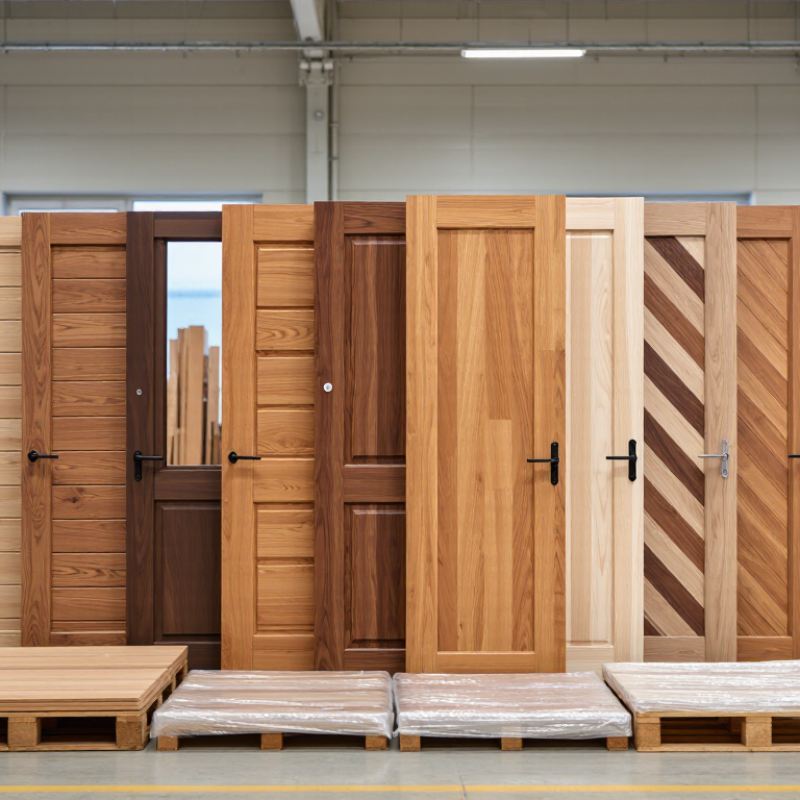
Barn Door Slabs Defined: Materials, Core Types, and ANSI/WDMA I.S. 1A
A barn door slab is the moving door leaf, supplied without its surrounding frame and usually without track hardware. Its face may be solid wood, wood veneer, or a paint-ready engineered panel. The core matters: honeycomb cores reduce weight, while particleboard, MDF, and stave-lumber cores offer different levels of mass, stability, and screw-holding capacity. No core is best for every opening. A heavy slab may feel substantial, but it also places greater demands on the track and wall blocking.
For interior architectural wood flush doors, ANSI/WDMA I.S.1A-21 defines Standard, Heavy, and Extra Heavy Duty performance levels. These describe tested door performance, not a guarantee that a slab suits every barn-door track or installation. The USDA Forest Products Laboratory’s Wood Handbook reports equilibrium moisture content of about 6% at 70°F and 30% relative humidity, rising to roughly 11% at 60% relative humidity. That seasonal shift can affect wood dimensions.
Small gaps matter. In practice, check the slab’s core, thickness, weight, finish, and standard documentation against the opening and hardware requirements. One detail buyers sometimes overlook: a listed performance level does not, by itself, confirm that the complete sliding-door assembly has been tested.
Size Benchmarks: 80 × 36-Inch U.S. Reference and 1⅜-Inch Interior Slabs
For global buyers, 80 × 36 inches is a useful U.S. reference for a common 3-foot-by-6-foot-8-inch interior door. Treat it as a benchmark, not a universal order size. A slab’s stated width and height do not include the frame or track clearance. Measure the existing opening, then confirm the required overlap and hardware space with the installer. Small differences matter. A few millimeters can affect a clean, even reveal.
Thickness needs equal attention. The Window & Door Manufacturers Association’s ANSI/WDMA I.S. 1A standard for architectural wood flush doors includes 1⅜-inch thickness as a recognized option. That makes it a practical reference for interior slab comparisons, though local specifications and existing hinges may call for another thickness. Check hinge depth, edge treatment, and finished-floor clearance before approving production. A tape measure can catch surprises. Even so, measurements taken from an old slab may be imperfect, especially if its edges are worn or trimmed. Cite the standard and record dimensions in both inches and millimeters to reduce avoidable quoting errors.
How to Compare 10 Manufacturers: MOQ, Capacity, Lead Time, and Certifications
Comparing ten barn door slab manufacturers requires more than checking quoted prices. Request each supplier’s minimum order quantity for standard slabs and custom sizes. A low MOQ may suit a trial order, but confirm whether it applies to every finish and configuration. Ask for a written production capacity per month, not a general claim. Capacity should reflect the slab material, dimensions, and finishing process you actually need.
Lead time needs careful definition. Ask when the clock starts: after deposit, drawing approval, or sample sign-off. Request separate estimates for production, packing, and transport, then compare them using the same shipping assumptions. A factory may quote a short production window but exclude time for custom packaging or inspection. Small details matter. Ask for proof.
Certifications should match the product and destination market. Request current documents, the issuing organization, covered materials, and model or product scope. A certificate for a coating or component does not automatically verify the complete door slab. Check whether test reports identify the construction you plan to order. Samples can reveal edge quality, surface consistency, and how the slab feels in hand, though one sample cannot prove repeat production quality. Keep your comparison sheet simple: MOQ, monthly capacity, confirmed lead time, document scope, and sample findings. Some suppliers may answer vaguely; record that uncertainty rather than treating estimates as guarantees.
10 Best Barn Door Slab Manufacturers: Product Range and Export Markets
Barn door slab manufacturers vary widely in product range. Some offer solid-wood slabs, while others focus on engineered cores with wood veneers. Common choices include knotty or clear faces, unfinished surfaces, and factory-applied stains. Buyers should check slab thickness, edge construction, and available widths. These details affect track compatibility and the finished appearance. A sample can reveal grain variation that catalog photos hide.
Export markets shape what manufacturers can supply reliably. Ask whether standard dimensions suit your project or require custom cutting. Confirm packaging protects corners and faces during long-distance shipping. Request written details on moisture content, finish options, lead times, and replacement-part availability. Export experience is useful, but it does not guarantee consistent communication. One awkward point: product data can be incomplete, so clarify assumptions before placing an order.
Tips: Compare specifications, not just photos. Request a finish sample and a packing description. Check whether the quoted price includes protective packaging. Keep a small tolerance allowance for site measurements; walls and openings are rarely perfect. A clear, documented order reduces avoidable surprises.
Global Buyer Checks: FSC Chain of Custody, Moisture Content, and Warranty Terms
Global buyers should verify FSC Chain of Custody documents against the supplier’s legal entity, product scope, and certificate status. FSC-STD-40-004 sets traceability requirements for certified material; a certificate alone does not prove that a particular barn door slab carries a valid claim. Match the claim on the invoice to the product and shipping records. Paperwork can lag. Ask the supplier to resolve mismatched names or claims before production, not after the container ships.
Moisture content deserves an actual reading, not a verbal assurance. The USDA Forest Products Laboratory’s Wood Handbook (2021) places wood’s fiber saturation point near 30% moisture content; below that point, further drying causes shrinkage. This matters when a slab moves from a humid warehouse into a heated home. Request readings from several locations, the meter type, and the test date. Ask how the slab was acclimated. One reading is not enough.
Warranty terms should name the covered defects, claim period, remedy, and exclusions for installation or environmental conditions. Check whether warping, finish failure, and delamination are treated separately. A short warranty may be workable, but only if its limits are clear. Keep approved drawings, moisture records, and delivery photos; these details can make a later claim easier to assess.