Choosing the right storefront glass door is not simply a matter of matching a frame to a façade. The entrance must manage traffic, weather, security, accessibility, maintenance, and daily operating costs. A narrow retail doorway may need a lightweight aluminum frame and tempered safety glass. A busy supermarket entrance may require automatic operation, laminated glass, stronger hardware, and wider clearance. Small details matter. A dragging door becomes expensive quickly.
The International Energy Agency’s Buildings 2023 report states that buildings represent about 30% of global final energy consumption and 26% of energy-related emissions. This makes glazing performance more than a design preference. It becomes part of responsible building management. The National Fenestration Rating Council recommends reviewing U-factor, solar heat gain coefficient, and visible transmittance when comparing fenestration products. These ratings help buyers understand heat flow, sunlight, and daylight performance. However, ratings alone do not guarantee a successful installation. Poor sealing, incorrect hardware, or heavy traffic can undermine a high-performing product.
A reliable storefront glass door selection also follows recognized standards, including those referenced by AAMA and ASHRAE. Local climate, entrance orientation, and user behavior should guide the final decision. A door facing intense afternoon sun may need different glass from one protected beneath a deep canopy. There is no universal winner. Even experienced specifiers can overlook maintenance access or operator noise. The best storefront glass door balances appearance, safety, energy performance, and long-term serviceability. This guide examines those practical choices with evidence, not assumptions.
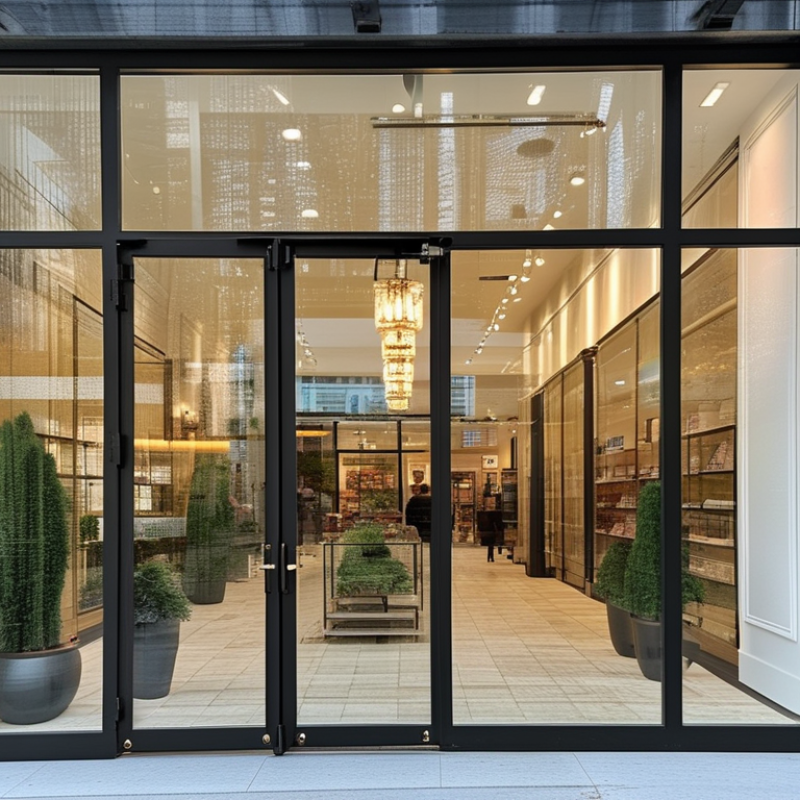
A storefront glass door must support daily traffic, security, comfort, and visual appeal. Measure opening width, ceiling height, and available swing space before choosing a system. A busy café may need a durable, easy-to-clean entrance. A boutique may prefer slim sightlines and larger glass areas.
Energy performance deserves equal attention. The U.S. Energy Information Administration’s 2018 Commercial Buildings Energy Consumption Survey reports that lighting used 17% of commercial building energy. Natural daylight can reduce lighting demand, but poorly specified glass may increase glare and heat gain. Look for low-emissivity glass, suitable solar-control performance, and properly sealed frames. The U.S. Department of Energy also identifies windows as a major source of heat loss and gain. Glass doors should not be treated as decoration alone.
Aesthetics should follow the building’s character, not overpower it. Clear glass creates openness, while tinted or textured options add privacy and shade. However, darker glass can make a welcoming shop feel closed. This is where judgment becomes difficult. Design drawings rarely show afternoon glare or rainwater near the threshold. Visit a completed installation if possible. A practical door may look less dramatic, yet perform better for staff and visitors.
How to Choose the Right Storefront Glass Door?
Compare Glass Types for Safety, Privacy, and Natural Light
A clear storefront door invites daylight, but maximum transparency is not always practical. In site reviews, I look at safety, glare, visibility, and cleaning conditions together. Tempered glass is approximately four times stronger than annealed glass, according to ASTM C1048 guidance. When it breaks, it usually granulates into smaller pieces. Laminated glass uses an interlayer that keeps fragments attached after impact. It can offer better post-breakage protection, although it may cost more and appear slightly less neutral.
Privacy matters. Frosted or acid-etched glass softens views while preserving useful daylight. Patterned glass can create privacy near eye level, leaving a clear band above for wayfinding. Select glass by visible light transmittance, not appearance alone. The U.S. Energy Information Administration’s 2018 Commercial Buildings Energy Consumption Survey reports that lighting used about 17% of commercial building site energy. Better daylight distribution may reduce artificial-light demand, but glare can undermine that benefit. Low-emissivity coatings and solar-control glass can help, especially on sun-facing entrances. Their performance depends on orientation, framing, and interior layout. That trade-off is real.
A practical specification might combine laminated safety glass, a translucent privacy zone, and a clear upper panel. The final choice should reflect traffic patterns, nearby displays, climate, and cleaning routines. I have seen attractive glass selections fail because fingerprints, reflections, or harsh afternoon light were ignored. Design flexibility is useful, but measurable performance should lead the decision.
How to Choose the Right Storefront Glass Door?
Choose the Door Configuration, Frame, and Hardware
A storefront glass door should match customer flow, opening width, and daily use. Measure the clear opening, not only the rough opening. A single door suits narrow entries and quieter shops. Double doors improve movement for carts, deliveries, and busy periods. An offset pair can preserve display space while widening access. Sliding systems may help where swing clearance is limited, but their tracks need regular cleaning. I have seen attractive layouts fail because the door path blocked a customer queue.
The frame affects strength, sightlines, and maintenance. Aluminum frames offer a practical balance between weight and durability. Narrow profiles provide more glass, yet they may feel less forgiving after repeated impact. Select a finish that hides fingerprints and matches the surrounding facade. Thermal performance also matters in conditioned spaces. A poorly specified frame can create drafts near the entrance. That detail is easy to miss.
Hardware should fit the door’s weight, traffic level, and user habits. Use properly rated hinges, closers, locks, pulls, and panic-release equipment where local codes require them. A closer that shuts too quickly can startle customers and damage the frame. A weak pull handle may loosen within months. Test the door with packages, gloves, and mobility devices before approval. I would also review service access; replacing a concealed part can become unnecessarily difficult. Ask an experienced installer to verify clearances, safety glazing, anchoring, and final operation on site.
| Selection Area | Common Option | Recommended Application | Advantages | Important Considerations |
|---|---|---|---|---|
| Door Configuration | Single hinged door | Small retail entrances, offices, clinics, and low- to medium-traffic locations | Simple operation, compact footprint, and straightforward installation | Confirm the door swing, required maneuvering clearance, and available wall space before ordering. |
| Door Configuration | Pair of hinged doors | Wide entrances, high-traffic storefronts, and locations that occasionally require large access clearance | Provides a wider passage and can improve customer flow | Requires more wall and floor space. One leaf may need to function as the primary active door for everyday use. |
| Door Configuration | Single sliding door | Entrances with limited swing clearance or layouts where keeping the doorway area open is important | Does not require a conventional door swing and can support efficient space planning | Needs adequate side space for the sliding panel and a properly aligned track or sliding mechanism. |
| Door Configuration | Automatic sliding door | Busy retail stores, supermarkets, transportation facilities, and accessible public entrances | Reduces manual contact and supports frequent two-way traffic | Requires compatible sensors, safety controls, regular maintenance, and a suitable power supply where applicable. |
| Door Configuration | All-glass pivot door | Architectural storefronts, showrooms, hospitality spaces, and entrances designed for a prominent visual appearance | Creates a clean, frameless appearance and can accommodate large glass panels | Requires accurate structural coordination because the pivot hardware transfers loads to the floor, ceiling, or surrounding structure. |
| Frame Selection | Aluminum frame | Most commercial storefront entrances, especially where low maintenance and corrosion resistance are priorities | Lightweight, durable, corrosion-resistant, and available in multiple finishes | Thermal performance depends on the frame design. Select a finish suitable for the exposure and cleaning routine. |
| Frame Selection | Framed glass door with perimeter rails | High-use entrances where additional edge protection and a more substantial door appearance are desired | Protects glass edges and provides convenient locations for locks, pulls, and closers | Frame dimensions may reduce the visible glass area and should be coordinated with adjacent storefront framing. |
| Frame Selection | Frameless tempered-glass door | Interior-facing retail environments and design-focused entrances where maximum transparency is preferred | Minimal visual obstruction and a modern appearance | Requires specialized hinges, pivots, clamps, and glass fabrication. Hardware alignment is especially important. |
| Glass Selection | Tempered safety glass | Most commercial doors and locations where impact safety is required by applicable building regulations | Heat-treated glass that is stronger than ordinary annealed glass and breaks into relatively small particles when fractured | It cannot be cut or modified after tempering. Openings, notches, and hardware preparations must be finalized before fabrication. |
| Glass Selection | Laminated safety glass | Locations prioritizing post-breakage retention, security, noise reduction, or enhanced weather performance | Interlayer helps hold the glass together after breakage and can improve sound-control performance | Usually heavier and may require compatible frames, hinges, and structural support. |
| Hardware | Door closer | Hinged storefront doors that must return to the closed position after use | Helps control closing speed and supports security, weather control, and energy management | Choose a closer rated for the door weight, width, traffic level, and opening conditions. Adjust closing and latching speeds carefully. |
| Hardware | Pull handle with separate lock | Retail and office doors where a clear, easy-to-use handle and standard locking function are needed | Simple operation, easy replacement, and broad compatibility with framed or frameless door designs | Handle length and mounting location should allow comfortable use without interfering with the lock or adjacent frame. |
| Hardware | Lever handle and latch | Entrances requiring one-handed operation and frequent daily use | Generally easier to operate than a round knob, especially for users carrying items | Confirm accessibility requirements, latch compatibility, and whether the door is intended for single- or double-action use. |
| Hardware | Electromagnetic or electric locking hardware | Controlled-access storefronts, offices, and entrances integrated with access-control systems | Supports electronic credentials, scheduled access, and integration with security systems | Coordinate power, emergency release, fire-safety requirements, and fail-safe or fail-secure operation with qualified professionals. |
| Hardware | Floor or wall-mounted door stop | Hinged doors exposed to repeated opening or strong wind conditions | Helps prevent the door from striking nearby glass, walls, displays, or hardware | Install the stop where it will not create a trip hazard or interfere with the required door swing and clearances. |
| Performance and Compliance | Clear opening and accessibility | Public entrances and commercial buildings subject to accessibility regulations | Improves usability for people using mobility devices, carrying goods, or moving through the entrance with assistance | For U.S. projects, a common accessibility benchmark is a minimum 32-inch clear opening for an accessible door leaf; verify the governing local code and full maneuvering-clearance requirements. |
| Performance and Compliance | Safety markings on large glass areas | Fully glazed doors and sidelites in busy pedestrian areas | Improves visibility of the glass barrier and can reduce accidental collisions | Use visible, durable markings at appropriate heights and confirm requirements with the applicable safety-glazing and building codes. |
| Final Selection Checklist | Match the complete door system | Any storefront project before fabrication or installation | Ensures that configuration, glass, frame, hinges, closer, lock, and surrounding structure work together | Verify opening dimensions, door weight, traffic frequency, climate exposure, security needs, accessibility, local codes, and maintenance access. |
A storefront door should control heat, welcome visitors, and resist daily abuse. Start with the building’s climate and entrance direction. Strong afternoon sun may create glare and uncomfortable indoor temperatures. Low-emissivity glass, suitable solar heat gain control, and thermally improved frames can reduce these problems. Check the glass’s U-factor and air leakage rating. They reveal more than appearance alone. I once saw a bright entrance perform poorly because its frame conducted heat around the glazing.
Accessibility deserves practical testing, not assumptions. Measure the clear opening with the door fully open. Confirm that the threshold does not catch mobility devices or create a tripping edge. Handles should be easy to grip with one hand. The closing force must not make entry exhausting. Leave enough maneuvering space for someone using a wheelchair. Add visible contrast markings when reflections hide the glass. Small details matter.
Security should support, not obstruct, public access. Laminated safety glass can help resist impact and reduce dangerous shattering. Strong hinges, protected locking points, and controlled door closers add useful protection. Yet excessive hardware may slow evacuation or confuse visitors. Verify local building and accessibility requirements with a qualified professional. No checklist is perfect. Test the door during a busy period, in rain, and after closing time. A design that feels secure in a showroom may behave differently on a crowded sidewalk.
Choosing the right storefront glass door starts with accurate measurements. Record the rough opening, finished floor height, wall thickness, swing clearance, and threshold condition. Measure width and height at three points. Older buildings rarely stay perfectly square. That small detail matters.
The U.S. Department of Energy reports that windows can account for 25–30% of residential heating and cooling energy use. Storefront doors are not identical to home windows, but the principle remains useful. Glass area, frame quality, seals, and alignment influence comfort and operating costs. Ask for the glass configuration, U-factor, visible transmittance, and air-leakage information. Do not rely on a vague “energy-efficient” claim. It sounds impressive, but it explains very little.
Installation needs deserve equal attention. Confirm whether the existing structure can support the door, closer, hinges, and daily traffic. The National Glass Association recommends following documented glazing practices and checking clearances, setting blocks, and edge protection. A few millimeters of poor alignment can create rubbing, drafts, or premature hardware wear. Plan drainage around the sill, especially where rain reaches the entrance. Maintenance should include quarterly inspections of seals, pivots, closers, and fasteners. Clean glass with non-abrasive materials. In practice, I have seen beautiful doors fail because the threshold was ignored. I would not repeat that mistake. Consult the project’s applicable building and accessibility requirements before ordering.
Confirm the rough opening, clear opening, threshold height, and maneuvering space before ordering. The benchmarks below are common U.S. accessibility requirements for manual doors and should be verified against local building codes and site conditions.
Maintenance note: After installation, inspect door alignment, pivots, closers, locks, weather seals, and safety glazing regularly. Clean glass and hardware according to the manufacturer’s instructions, and repair dragging, loose, or difficult-to-operate doors promptly.