A sliding glass door can look simple: a clear panel, a frame, and a narrow track. Yet its smooth movement depends on several carefully matched components. Sliding glass door hardware usually includes rollers, tracks, handles, locks, guides, bumpers, and adjustment screws. Each part carries a practical responsibility. The rollers support the door’s weight. The track controls its path. The lock secures the meeting point between moving panels.
Tom Silva, a veteran master carpenter known for his work on This Old House, has often emphasized a basic installation principle: “A door is only as good as the opening it’s installed in.” That observation explains many common failures. A slightly uneven sill can make the panel drag. Worn rollers may create a grinding sound. Loose hardware can leave the door shaking when you pull the handle. Small details matter.
The system works through controlled weight transfer. Rollers attached beneath the panel move along the track while guides keep the upper edge aligned. Adjustment screws can raise or lower the panel, helping installers correct minor alignment problems. However, adjustment cannot repair a badly damaged frame. That distinction is easy to miss. It also shows why experienced inspection matters before replacement.
In this guide, we will examine how each hardware component works, how professionals diagnose common problems, and how homeowners can recognize safe maintenance needs. The goal is not merely quieter movement. It is reliable operation, better security, and fewer premature repairs. Even well-made hardware can fail when cleaning, alignment, or installation receives too little attention.
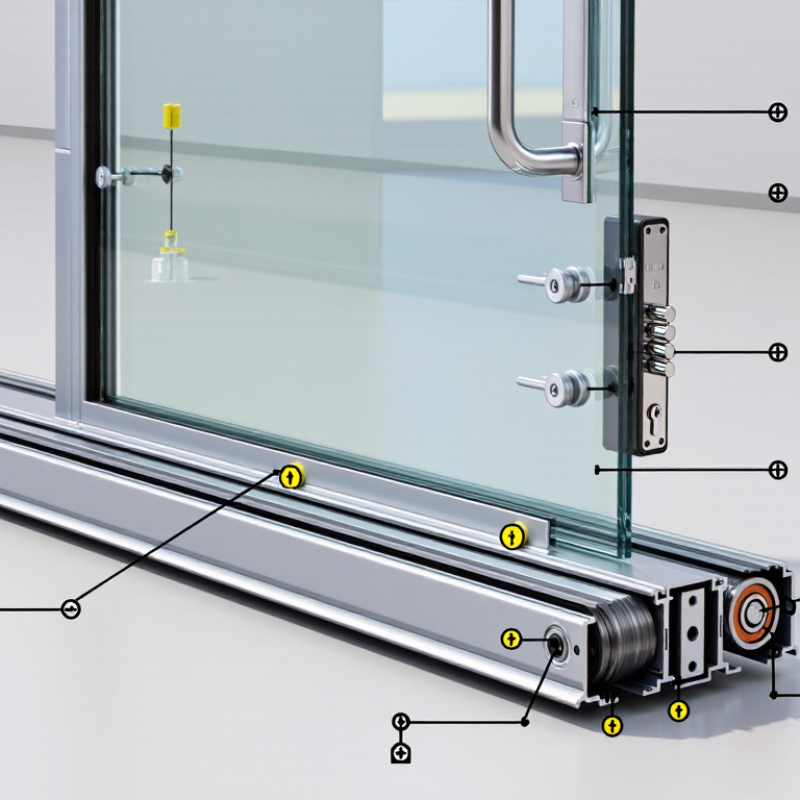
Sliding glass door hardware is the collection of parts that supports, guides, secures, and moves a glass door. It usually includes rollers, tracks, handles, locks, guides, and adjustment screws. Rollers sit beneath the door panel and carry its weight along the track. The track keeps movement straight, while the bottom guide reduces side-to-side swinging. Handles provide a controlled grip, and locks hold the panel against the frame when closed. Small parts matter.
In practical use, clean alignment is just as important as strong hardware. Dust, pet hair, and tiny stones can collect inside the track. This creates resistance and may wear the rollers unevenly. A technician often checks whether the door sits level before replacing any component. Turning an adjustment screw slightly can improve movement, but excessive adjustment may strain the frame. I have found that many sticking doors do not need new hardware. They need careful cleaning and balanced rollers.
Hardware materials vary by location and workload. Stainless steel resists moisture, while coated metal can suit ordinary indoor conditions. Plastic guides may reduce noise, but they can wear faster under frequent use. Safety also depends on secure glass panels, reliable locks, and correctly fitted stops. No system is perfect. Even well-installed hardware needs periodic inspection, especially when the door feels heavy, rattles, or leaves a visible gap.
Sliding glass door hardware is the set of mechanical parts that supports, guides, moves, seals, and secures a glass door panel. The chart shows the common quantity of each hardware element in a typical single-panel sliding door assembly; exact quantities vary by door design and installation requirements.
How it works: Rollers carry the panel and move along the track, while the top track and bottom guide keep the panel aligned. Handles and locks provide control and security, seals reduce air and water leakage, and stops limit the panel’s travel.
A sliding glass door system is more than two moving glass panels. Its performance depends on several small, coordinated components. The main parts include the frame, glass panels, rollers, track, guides, lock, handle, weatherstripping, and anti-lift blocks. Each part has a specific job.
The panels carry the glass and move along the lower track. Rollers sit beneath each panel, allowing smooth movement with limited effort. The upper guide keeps the panel aligned and reduces sideways movement. The track must remain straight and clean. Even a small dent can create noise, resistance, and uneven wear.
The frame supports the entire assembly and connects it to the wall opening. Weatherstripping closes narrow gaps around the panels, helping control drafts and moisture.
The U.S. Department of Energy reports that windows can cause 25% to 30% of residential heating and cooling energy use. This makes glass selection important. Low-emissivity coatings, insulated glass, and suitable solar heat-gain control can improve comfort. The National Fenestration Rating Council evaluates products through U-factor and solar heat-gain ratings. These figures help compare thermal performance more reliably.
Still, ratings do not replace careful installation. A well-rated door can perform poorly when the sill drains badly or the rollers are misadjusted. That detail is often overlooked. Inspectors should check movement, locking pressure, frame alignment, and visible gaps after installation.
Sliding glass door hardware is the working system behind smooth, quiet opening. It usually includes a track, rollers, guides, stops, handles, and safety retainers. When you pull the handle, the panel transfers force to its rollers. The rollers turn inside the track, carrying much of the panel’s weight. Small guides keep the glass aligned and reduce sideways movement.
This sounds simple. It is not always simple. Dust, an uneven track, or worn bearings can make the panel drag. During field checks, I look at the gap between the panel and frame before adjusting anything. An uneven gap often reveals a deeper alignment problem. Adjustable roller housings can raise or lower the panel by a few millimeters. That small change may restore an even seal and prevent scraping. Stops control travel at open and closed positions. Anti-jump devices help keep the panel seated during normal use. However, hardware cannot correct every installation error. Excessive force may damage rollers, loosen fasteners, or stress nearby materials.
Clean the track with a soft brush and vacuum.
Avoid thick grease because it traps grit.
Test the door slowly.
If it still binds, stop forcing it and check alignment.
I have learned that a quiet door is not always a healthy door; loose hardware can hide behind easy movement.
Sliding glass door hardware includes rollers, tracks, handles, guides, locks, and adjustment screws. These parts carry the glass, control movement, and keep the panel aligned. Materials strongly affect performance. Stainless steel resists moisture and suits bathrooms, coastal homes, and busy entrances. Aluminum is lighter and usually easier to machine. It also supports clean, narrow frame designs. Brass adds visual warmth, but it needs suitable finishing in damp areas.
Rollers often use sealed bearings inside metal or reinforced polymer housings. Sealed bearings help limit dust and reduce maintenance. Polymer wheels can move quietly, though poor formulations may wear faster under heavy glass. Tracks may be recessed into the floor or mounted on top. Recessed designs look refined and reduce trip edges, but they collect grit more easily. Surface-mounted tracks simplify installation and cleaning. Neither design is perfect.
Handle shapes should match hand clearance and door weight. Long pull handles provide leverage, while compact recessed pulls preserve a flat appearance. Frameless systems depend on precise clamps and carefully positioned guides. Framed systems offer more protection around the glass and can hide adjustment hardware. During installation, even a small track error can create dragging or uneven gaps. It must stay aligned. I have found that quiet operation is not proof of quality; fasteners, drainage, and future adjustment access matter just as much. A polished design can still disappoint when replacement parts are difficult to source.
| Hardware Component | Primary Function | Common Materials | Typical Design Options | How It Works | Important Selection Factors |
|---|---|---|---|---|---|
| Top Roller System | Supports and guides the glass door from an overhead track. | Stainless steel, galvanized steel, aluminum, engineering-grade polymers | Single roller, tandem roller, adjustable roller, concealed carriage | Wheels run inside or along a top track, carrying the door weight while allowing horizontal movement. | Door weight, track capacity, wheel diameter, adjustment range, and corrosion resistance |
| Bottom Roller System | Supports the door panel from below and reduces the load on the upper structure. | Stainless steel, steel, aluminum, nylon or acetal wheel components | Recessed floor track, surface-mounted track, adjustable bearing roller | Load-bearing wheels travel on a floor-mounted rail while upper guides keep the panel aligned. | Floor strength, drainage, debris control, accessibility, and maintenance requirements |
| Sliding Track or Rail | Provides the path on which rollers travel. | Stainless steel, anodized aluminum, galvanized steel | Exposed round rail, rectangular rail, concealed track, single or multi-panel track | The rail maintains the direction of movement and transfers operating loads to the wall, ceiling, or floor structure. | Track straightness, load rating, installation surface, drainage, and cleaning access |
| Guide Channel or Floor Guide | Prevents the bottom of the glass panel from swinging or drifting sideways. | Aluminum, stainless steel, nylon, acetal, rubber inserts | U-channel, fin guide, recessed guide, surface-mounted guide | A guide engages with the lower edge or a guide block on the door, limiting lateral movement without carrying the main load. | Compatibility with glass thickness, threshold design, dirt accumulation, and trip resistance |
| Hangers and Clamps | Connect the glass panel to the roller carriage or support structure. | Stainless steel, aluminum, zinc alloy, EPDM or silicone gaskets | Top-mounted clamp, side-mounted hanger, point-fixed fitting, concealed connector | Clamping surfaces hold the glass through friction and protective gaskets, distributing pressure around the attachment area. | Glass thickness, safety glazing compatibility, clamp pressure, edge clearance, and load rating |
| Glass Door Handle | Provides a safe and convenient gripping point for opening and closing. | Stainless steel, aluminum, brass, wood, nylon | Back-to-back pull handle, ladder pull, recessed pull, edge pull | The user applies force to the handle, transferring movement to the door panel and roller system. | Grip comfort, handle projection, fixing method, clearance from adjacent panels, and finish durability |
| Locking Mechanism | Secures the sliding panel in the closed position. | Stainless steel, zinc alloy, brass, hardened steel, polymer components | Hook lock, mortise lock, surface bolt, floor bolt, latch lock | A hook, bolt, or latch engages with a keeper or receiver fixed to the frame or adjacent panel. | Security level, alignment tolerance, emergency release needs, corrosion resistance, and installation depth |
| Soft-Close Damper | Slows the door near the end of travel to reduce impact and noise. | Steel, stainless steel, aluminum, hydraulic fluid, engineering-grade polymers | Hydraulic damper, pneumatic damper, concealed soft-close unit | A spring and damping mechanism absorbs kinetic energy and guides the panel gently into its final position. | Door mass, closing speed, adjustment range, cycle life, and compatibility with the roller carriage |
| End Stops and Anti-Jump Devices | Limit travel and help prevent the panel from lifting out of the track. | Stainless steel, galvanized steel, aluminum, nylon | Adjustable stop, fixed stop, anti-lift clip, safety retaining bracket | Stops absorb or restrict end-of-travel movement, while retaining devices maintain contact between the rollers and track. | Impact resistance, stopping position, installation accuracy, and safety clearance |
| Seals and Brush Strips | Reduce air movement, dust entry, light gaps, and rattling between moving surfaces. | EPDM, silicone, PVC, polyurethane, polypropylene brush fibers | Wiper seal, compression seal, pile brush, interlock seal | Flexible sealing elements compress or brush against the frame and neighboring panel as the door closes. | Weather exposure, compression tolerance, glass movement, replacement access, and thermal performance |
| Glass Support Gaskets | Protect the glass from direct contact with rigid metal fittings. | EPDM, silicone, neoprene, polyurethane | Full-face gasket, edge gasket, molded insert, adhesive-backed pad | The gasket distributes clamping pressure, adds friction, and helps absorb vibration between the glass and hardware. | Glass thickness, chemical compatibility, UV resistance, temperature range, and compression set |
| Common Hardware Finishes | Protect metal surfaces and provide a consistent visual appearance. | Brushed stainless steel, polished stainless steel, anodized aluminum, powder-coated metal, PVD-coated metal | Brushed, satin, polished, matte, dark metallic, clear anodized | Surface treatments improve resistance to oxidation, wear, and staining while influencing the appearance and maintenance needs of the hardware. | Humidity, salt exposure, cleaning chemicals, abrasion, color consistency, and maintenance frequency |
| Typical Sliding Door Configurations | Determine how panels move and how the hardware is arranged. | Compatible combinations of glass, steel, aluminum, and polymer components | Single sliding panel, bypass panels, telescopic panels, pocket door, fixed panel with sliding panel | Rollers carry each movable panel along one or more parallel tracks, while guides and stops control alignment and travel. | Available wall space, opening width, panel weight, stacking area, accessibility, and installation structure |
Sliding glass door hardware includes rollers, tracks, guides, locks, handles, and weatherstripping. Maintenance starts with a clean track. Vacuum grit, then wipe it with a dry cloth. Do not flood the channel; trapped water can corrode fasteners. Inspect rollers every six months, especially when the panel feels heavy or scrapes. A door should glide with steady pressure, not shoulder force. The U.S. Department of Energy reports that air leakage can represent 5%–30% of a home’s heating and cooling energy. Worn seals affect comfort, not just appearance.
Check the pile seal for gaps, flattened fibers, or brittle edges. Replace seals using the original profile, after measuring the entire opening. ENERGY STAR guidance estimates that air sealing may reduce annual energy costs by about 10%. Actual savings vary with climate, installation quality, and household behavior. It is guidance, not a promise. Adjust roller screws in small turns, keeping the panel level. Use only approved lubricant on metal contact points. Avoid oil on nylon rollers; it attracts abrasive dust.
Replacement becomes sensible when rollers remain rough, the track is deeply grooved, or the lock cannot engage securely. Photograph each part before removal. Record screw spacing and panel thickness. A compatible roller may still fail if its height range is wrong. I have seen rushed replacements create new drag. Check twice. After installation, test the lock, guide, seal compression, and panel stability. Follow the manufacturer’s instructions and local safety requirements. Sources: U.S. Department of Energy Energy Saver and ENERGY STAR Residential Air Sealing guidance.