Select Page

Top China Glass Door Hardware Suppliers for Global Buyers

Choosing reliable glass door hardware suppliers is a practical decision for architects, contractors, distributors, and commercial buyers worldwide. The right supplier affects more than appearance. It influences door safety, opening performance, installation time, maintenance costs, and customer confidence.

“Good hardware must serve the door, not compete with it,” says architectural hardware consultant Mark Ellison. His observation reflects a common purchasing mistake. Shiny finishes often attract attention first. However, load capacity, glass thickness, corrosion resistance, adjustment range, and replacement support matter more during daily use. A patch fitting that looks excellent in a showroom may perform poorly in a humid hotel entrance.

This guide examines leading China glass door hardware suppliers for global buyers. It considers product consistency, machining quality, material selection, factory experience, inspection procedures, customization, export packaging, and technical communication. Stainless steel grades, brass components, floor springs, hinges, handles, locks, and shower fittings require different evaluation methods. One supplier may excel at standard fittings. Another may provide stronger engineering support for complex projects.

Details reveal reliability.

Buyers should request drawings, test reports, sample approval, and clear warranty terms before placing volume orders. Factory photographs are useful, but they cannot replace physical inspection. That limitation deserves attention. Supplier websites may present polished images while hiding inconsistent polishing or weak packaging. Therefore, responsible sourcing combines documentation with samples, direct questions, and realistic project testing. The following supplier overview aims to make that process clearer, while recognizing that no ranking can replace careful due diligence.
Top China Glass Door Hardware Suppliers for Global Buyers

Market Scope: UN Comtrade HS 8302 Data and China’s Export Position

Top China Glass Door Hardware Suppliers for Global Buyers

UN Comtrade HS 8302 data gives buyers a useful starting point. The code covers base-metal mountings and fittings, including door and furniture hardware. It does not isolate glass-door fittings. This matters. China’s HS 8302 exports were approximately US$11 billion in 2023, based on UN Comtrade reporting and World Bank WITS trade records. China remains one of the category’s largest exporting economies. However, the figure includes many products beyond glass hardware. Treating it as a direct market size would be a weak assumption.

For global buyers, China’s export position suggests broad manufacturing capacity, dense supplier networks, and competitive shipment options. ITC Trade Map data also shows strong participation across Asia, Europe, and North America. Yet export value alone cannot confirm quality. Product drawings, load ratings, salt-spray results, and packaging controls need checking. In practice, a hinge may look precise but fail after repeated door cycles. That small gap can become a costly claim.

Tips: Compare HS 8302 export values with supplier-level evidence. Request stainless-steel grades, glass thickness ranges, test reports, and batch photos. Check whether the quoted product is truly for glass doors, not a general fitting under the same code. UN Comtrade figures may change after revisions, and customs classifications differ by country. That uncertainty deserves attention.

Product Taxonomy: Hinges, Patches, Locks, and Handles Under EN 1935

Global buyers should separate four hardware families before comparing Chinese suppliers: hinges, patches, locks, and handles. Each solves a different glass-door risk. EN 1935 applies mainly to mechanical hinges, not every item in this taxonomy. It classifies load, durability, corrosion resistance, and safety performance through an eight-digit coding system. That detail matters. A hinge marked only “tested” is weak evidence without its full classification and laboratory report. Mordor Intelligence’s 2024 Architectural Hardware Market report forecasts annual growth above 5% through 2029. Faster sourcing may follow, but speed can hide mismatched testing.

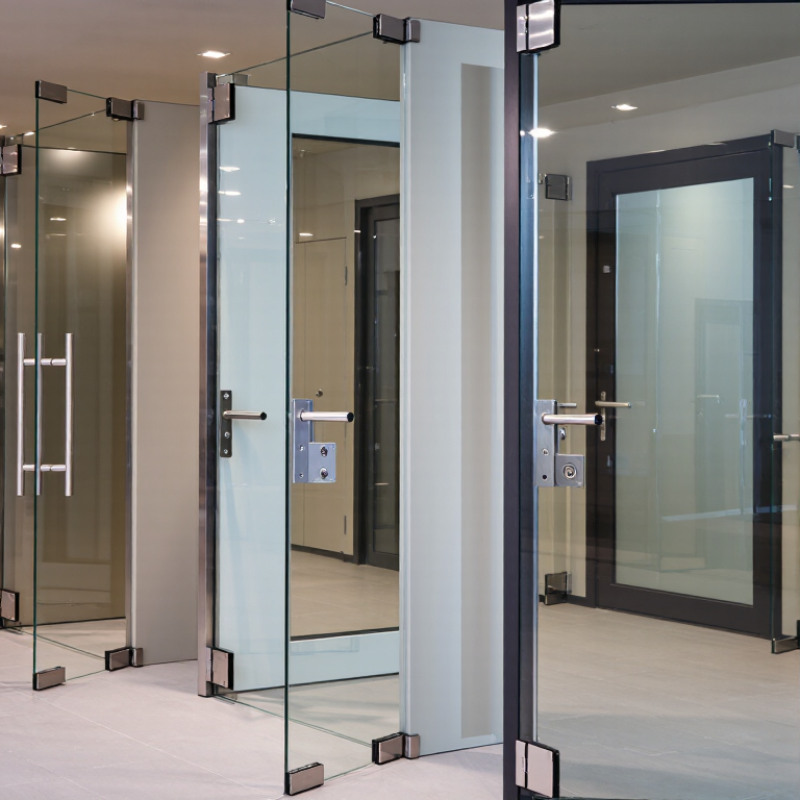
For hinges, request EN 1935 classification, batch traceability, load data, and cycle-test records. For patches, verify glass thickness, clamping torque, gasket material, and compatibility with door weight. Locks require cylinder security data, corrosion results, and emergency-egress suitability where applicable. Handles need pull-force testing, surface durability, and accurate spindle dimensions. Use EN 1935 as a hinge benchmark, not universal approval. A practical supplier audit should inspect samples, drawings, inspection records, and production controls, not photographs alone. I would still challenge salt-spray claims; laboratory hours rarely predict coastal maintenance perfectly. Small gaps remain. Written acceptance criteria should address them before purchase.

Material Benchmarks: 304 Steel with 18% Chromium vs 316 with 2–3% Molybdenum

For global buyers, glass door hardware starts with the alloy, not the polished finish. In many projects, 304 stainless steel contains about 18% chromium. This chromium forms a passive oxide layer that resists ordinary indoor moisture. It suits office entries, retail interiors, and dry hotel corridors. Yet fingerprints, cleaning chemicals, and coastal air can expose its limits. A bright surface is not proof of long-term performance.

316 stainless steel adds roughly 2–3% molybdenum, alongside chromium and nickel. Molybdenum improves resistance to pitting, especially where salt, chlorides, or frequent washing are present. That makes 316 a stronger choice for seaside buildings, pool areas, kitchens, and humid transport facilities. In my purchasing checks, the practical difference appears around hinge edges, clamp joints, and drainage points. These areas hold moisture longer. Still, 316 is not maintenance-free, and poor fabrication can defeat a better material. That detail matters.

Tips: Ask for the exact grade, test report, and finishing method. Check whether screws, washers, and glass clamps use compatible stainless steel. Inspect cut edges and welds, not only showroom samples. Rinse salt deposits with clean water and use a mild cleaner. Avoid chloride-heavy products. Test a small batch first. A supplier may quote 316, but documentation should confirm it. Cost is only one part of the decision.

Top China Glass Door Hardware Suppliers for Global Buyers

Material Benchmarks: 304 Stainless Steel with 18–20% Chromium vs 316 Stainless Steel with 16–18% Chromium and 2–3% Molybdenum

The chart uses representative midpoint values from commonly specified stainless-steel composition ranges. Grade 304 is typically characterized by approximately 19% chromium and 9.25% nickel, while grade 316 typically contains approximately 17% chromium, 12% nickel, and 2.5% molybdenum. Molybdenum improves resistance to chlorides and salt exposure, making 316 a stronger benchmark for coastal, humid, and high-corrosion glass-door hardware applications.

Safety Metrics: 4× Tempered-Glass Strength, EN 12150, and ANSI/BHMA A156.1

Top China Glass Door Hardware Suppliers for Global Buyers

Safety should be measured, not assumed. Thermally toughened glass is commonly rated at about four times the bending strength of annealed glass, according to National Glass Association technical guidance. That margin matters when a door panel meets a trolley, shoulder, or sudden temperature change. Yet “4× stronger” is not a complete specification. Edge quality, drilled holes, fitting pressure, and installation alignment can reduce real-world performance.

EN 12150-1 provides a practical benchmark for thermally toughened soda-lime safety glass. The standard specifies fragmentation behavior and a characteristic bending strength of 120 N/mm². Buyers should request compliance evidence, heat-soak information where relevant, and batch traceability. Small particles are expected after breakage. Sharp, large shards are not.

Hardware needs its own evidence. ANSI/BHMA A156.1 covers commercial architectural hinges, including endurance and operational performance requirements. It does not automatically certify every glass clamp, patch fitting, or door system. This distinction is often missed. Ask suppliers for test reports matching the exact configuration: glass thickness, hinge load, door width, cycle count, and fixing method. A polished certificate can still hide a weak installation detail. Field inspection remains necessary, especially around corners, gaskets, and over-tightened fasteners.

Top China Glass Door Hardware Suppliers for Global Buyers - Safety Metrics: 4× Tempered-Glass Strength, EN 12150, and ANSI/BHMA A156.1

Hardware Category Typical Glass Compatibility Primary Safety Metric Relevant Standard or Reference Recommended Buyer Verification Common Global Application
Glass Door Hinges Commonly designed for 8–12 mm toughened glass; exact limits depend on hinge design and door size. Load capacity, secure clamping, controlled closing, and resistance to repeated opening cycles. ANSI/BHMA A156.1 covers butt hinges and certain hinge performance requirements; it does not certify the glass itself. Request load-test results, cycle-test records, screw and fastener specifications, and installation limits. Interior glass doors, offices, hotels, retail entrances, and shower enclosures.
Patch Fittings Usually supplied for 10 or 12 mm toughened glass, subject to the fitting’s approved loading range. Stable glass retention, correct gasket compression, and prevention of metal-to-glass contact. Used with safety glass manufactured to EN 12150 where required by the project specification. Verify glass thickness, maximum door leaf dimensions, maximum mass, gasket material, and tightening torque. Frameless entrances, commercial partitions, showrooms, and architectural interiors.
Floor Springs Commonly paired with 8–12 mm glass doors; capacity varies by model and door dimensions. Controlled closing speed, latching action, hold-open function, and resistance to repeated use. ANSI/BHMA A156.1 may be relevant to hinge assemblies; floor-spring performance should be supported by separate manufacturer test data. Check tested door mass, maximum width, closing-angle range, cycle count, corrosion resistance, and adjustment instructions. High-traffic commercial doors, shopping areas, hotels, and public buildings.
Top Door Rails and Transoms Typically used with 10 or 12 mm toughened safety glass, depending on the rail system. Uniform clamping pressure, secure connection to the pivot or closer, and protection against edge damage. Glass should be specified and tested separately under EN 12150 when thermally toughened glass is required. Confirm approved glass type, hole and notch tolerances, fixing method, and tested door-size limitations. Entrance systems, office fronts, hotels, airports, and retail storefronts.
Glass Door Handles and Pull Handles Suitable for pre-drilled 8–12 mm glass when matched with the correct sleeves, washers, and fixing hardware. Secure fastening, smooth edges, adequate clearance, and resistance to loosening during use. Generally treated as architectural hardware; ANSI/BHMA A156.1 is not a universal handle standard. Request material grade, surface-finish test information, pull-out or torque-test data, and compatible hole dimensions. Retail doors, offices, hospitality projects, bathrooms, and residential interiors.
Glass Clamps and U-Channels Commonly supplied for 8, 10, or 12 mm glass; the selected profile must match the measured glass thickness. Positive retention, non-abrasive gaskets, edge protection, and resistance to slip. Used with safety glass specified under EN 12150 where applicable; hardware load performance requires separate evidence. Verify clamp width, gasket compatibility, fixing substrate, pull-out performance, and installation torque. Partitions, balustrades, shower screens, display cases, and glass walls.
Tempered Glass Panels for Door Assemblies Common architectural thicknesses include 8, 10, and 12 mm; project codes may require different thicknesses. Thermal toughening, fragmentation behavior, surface quality, and resistance to thermal and mechanical stress. EN 12150 specifies requirements and testing for thermally toughened soda-lime silicate safety glass. Request EN 12150 test documentation, thickness tolerance, fragmentation results, heat-soak details where specified, and permanent marking information. Frameless doors, partitions, façades, shower screens, and interior glazing.
Safety and Compliance Documentation Applies to the complete door assembly, including glass, fittings, fasteners, and supporting structure. Traceability, compatibility, documented testing, installation control, and compliance with local building regulations. The often-cited “4× strength” comparison is a general description of tempered glass versus annealed glass, not a substitute for EN 12150 certification. Obtain material certificates, batch traceability, dimensional drawings, test reports, installation manuals, and project-specific approvals. Global procurement, commercial construction, hospitality, retail, and public-sector projects.
Technical note: Tempered glass is commonly described as having approximately four times the bending strength of comparable annealed glass, but the actual performance depends on glass composition, thickness, edge quality, processing, and test method. EN 12150 addresses thermally toughened safety glass, while ANSI/BHMA A156.1 primarily addresses butt hinges and hinge-related hardware performance; neither standard alone certifies a complete glass-door assembly.

Supplier Screening: ISO 9001 Audits, MOQ, Lead Times, and Total Cost of Ownership

Screening Chinese glass door hardware suppliers requires more than checking a certificate logo. The ISO Survey 2022 recorded over 1.2 million ISO 9001 certificates worldwide, so certification alone proves little. Request the certificate number, issuing body, covered factory, expiry date, and latest audit findings. A remote audit is useful, but an on-site check can reveal mixed batches, weak gauge control, or unfinished corrective actions. Ask for inspection records on hinge alignment, load testing, corrosion resistance, and surface consistency.

MOQ and lead time should be tested against your installation schedule. Request separate quotations for samples, standard orders, custom finishes, packaging, and replacement parts. Record production days and shipping days independently. The World Bank’s 2023 Logistics Performance Index evaluates 139 economies and highlights persistent differences in customs, infrastructure, and delivery reliability. Build buffer time; supplier estimates are not always realistic. Total cost of ownership includes tooling, inspection, freight, import charges, breakage, installation labor, and future replacements. A lower unit price can become expensive when ten percent of fittings need rework. This happens more often than buyers admit. Calculate cost per installed door, not cost per handle. Keep written acceptance criteria, batch photos, and a small trial order before committing to a larger MOQ.